

All articles
Michaels FM On How Collaboration Turns Retail Facilities Into Proactive Business Partners
Preston McClanahan, Manager of Facilities Repairs and Maintenance at Michaels, shows how deep collaboration turns facilities from a reactive cost center into a strategic business partner.
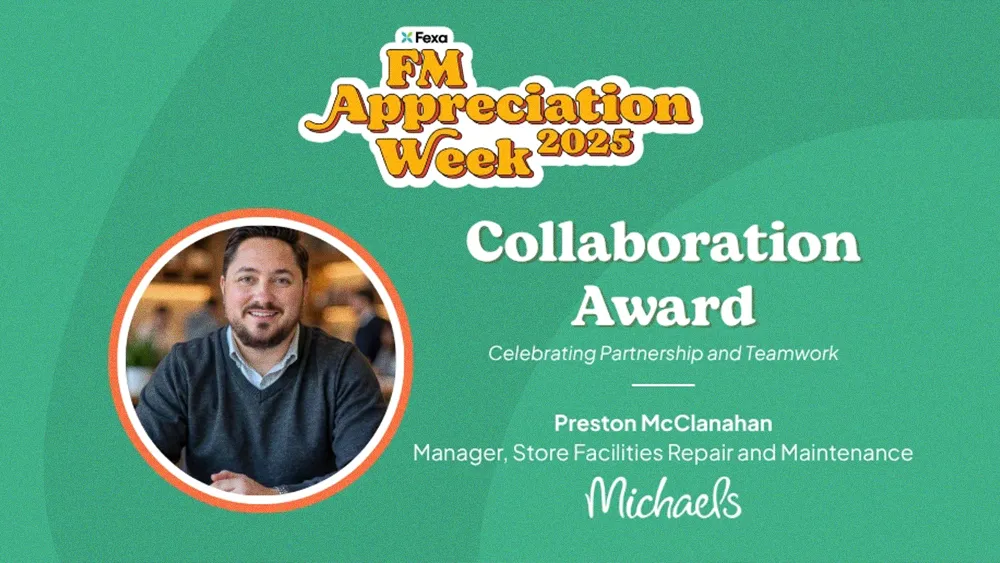

Facilities should be viewed as a key business partner, not an expense. While much of our work is reactive, if we're brought into the fold at the beginning, we can be proactive, avoid backtracking, and drive savings on the front end.

Facilities teams are often treated as a reactive cost center, brought in only after problems appear. But that mindset leaves real value on the table. When internal teams and external partners operate as one, facilities can shift into a proactive business role that prevents issues, manages costs, and supports the organization at scale.
That perspective is embodied by Preston McClanahan, Manager of Facilities Repairs & Maintenance at Michaels and recent recipient of Fexa's Collaboration Award, a testament to how he approaches facilities as a shared effort across teams and partners. He oversees repairs and maintenance for more than 1,300 stores across North America, managing a $120M budget in a complex retail environment. His outlook is shaped by experience on both sides of the role, having previously served as a District Manager, which gives him a clear understanding of how facilities decisions affect store teams day-to-day.
"Facilities should be viewed as a key business partner, not an expense. While much of our work is reactive, if we're brought into the fold at the beginning, we can be proactive, avoid backtracking, and drive savings on the front end," says McClanahan. His core message is a direct challenge to the traditional view of his industry, urging a redefinition of the facilities function. He says the path to driving real value begins when a department is treated as a strategic contributor.
Customer-centric: McClanahan’s push to operate proactively comes down to a simple rule. Every decision is filtered through who it ultimately serves, keeping the focus on the people who feel the impact most. "You're never going to have control. It ultimately comes down to taking care of the store and what's going to impact the business and the team. The store teams are our customers," he notes. "Anything we can do to improve how they work, the tools they use, or their working conditions will drive retention, increase sales, and boost customer satisfaction."
A playbook for retention: The real-world impact of this customer-centric philosophy is clear: McClanahan’s department has had no turnover in years, a rarity in an industry that often struggles with retention. That stability is the direct result of an internal leadership playbook designed to empower his team. "Rely on the team. Be transparent. Involve the team in all decision-making and bring them to the table," he advises. "That is how you develop people, drive retention, and foster engagement."
Attitude over aptitude: That stability doesn’t happen by accident. Hiring focuses less on perfect resumes and more on how people think, which has helped build a team that’s resilient, loyal, and brought into the fold from day one through mentorship and hands-on support. "I don't hire people for facilities experience; I bring in people who have a customer-centric mindset. For new hires, we use a shadowing environment and a buddy system. Not everyone is comfortable going to their supervisor, so giving them a partner on the team is how you build trust and drive engagement," McClanahan explains.
His perspective is personal, shaped by experience rather than theory. Having once sat on the other side of the relationship, he brings the mindset of the customer into the role, paired with an outsider’s willingness to question assumptions and rethink how familiar problems get solved.
The outsider's edge: "I was a district manager before I entered the facility space, and I learned the most from my vendors by calling them and asking questions. That lack of previous knowledge became an advantage, as it allows you to challenge how things are done and approach a repair from a completely different viewpoint." Coming in without a traditional facilities background turned out to be a strength for McClanahan, not a setback, opening the door to better questions and different ways of solving familiar problems.
Shifting sands: McClanahan describes the past year as a roller coaster, driven by industry-wide shifts, including the impact of tariffs and the uncertainty they create for facilities planning. In response, his team has been looking ahead, exploring how technology could support more proactive decision-making. "The big focus this year is implementing AI, finding the right platforms, and using data more proactively," he says. While Michaels has not yet implemented an AI platform, he notes that evaluating tools, partners, and governance considerations is already part of the effort to improve day-to-day operations and stay ahead of future challenges.
McClanahan closes by returning to the principle that runs through every part of his approach: trust. For him, vendors are not outside help brought in to execute tasks, but partners embedded in the mission itself. "Look at vendor partners not as a vendor, but as an extension of the team. If you have the right partners and empower them, they will do what is right for the store and the store team without even being asked," he concludes. "These partnerships shouldn’t be transactional. They have to be built on trust, respect, and that shared mission of taking care of the stores."

.webp)