

All articles
How Emser Tile Is Escaping the Reactive Maintenance Trap with Smarter Investments
Emser Tile's Mike McClure champions data-driven FM, turning reactive spending into proactive investment with AI and strategic insights to save money.

Most businesses and ownership are okay with being in a reactive state, but it just doesn't work for a facilities manager. Tools like Fexa help us present to our ownership and drive those future projects or larger projects, instead of just the day-to-day.
Facilities leaders can often find themselves in an endless loop of reactive maintenance, sometimes spending more to constantly fix old equipment than purchasing new. The core challenge, then, is justifying proactive investment to executives who aren't on the front lines. Making that budget case hinges on more than a gut feeling. The success is usually found in the data. It's about using asset histories and workflow analytics to prove a counterintuitive point: that spending money is often the best way to save it.
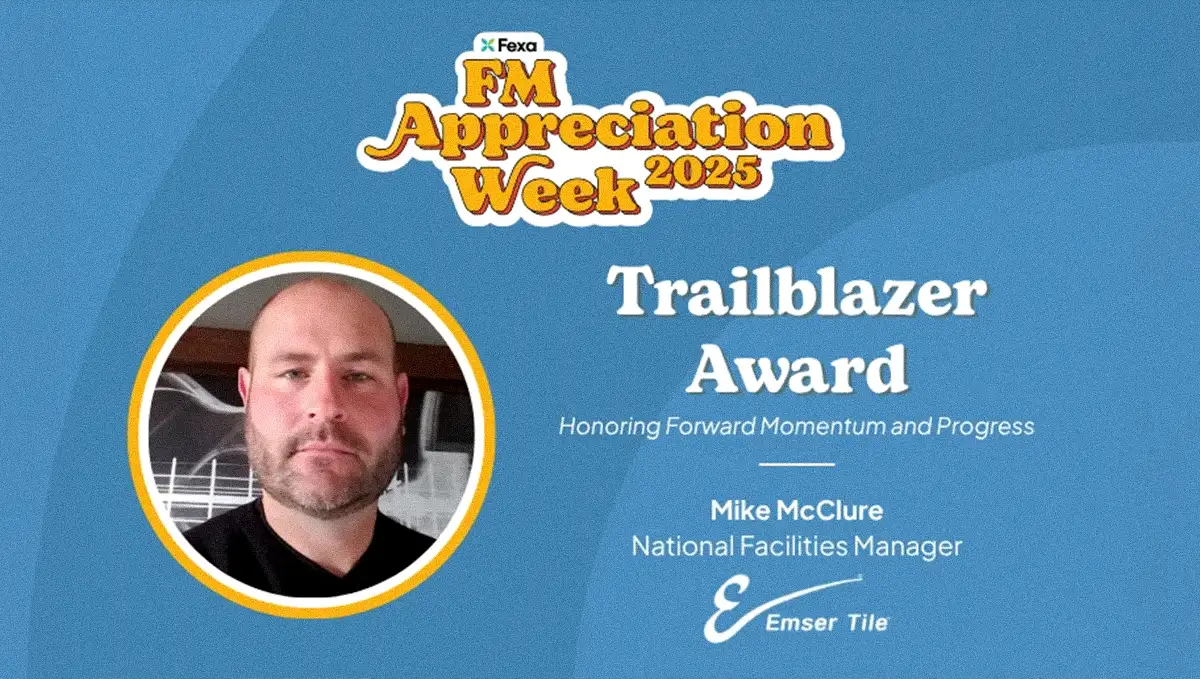
Embodying this data-driven approach is Mike McClure, National Facilities Manager for Emser Tile and a recent recipient of the Trailblazer Award for challenging convention and driving his organization forward. A 15-year veteran, McClure has risen through the ranks to oversee 82 locations spanning 1.8 million square feet. Leveraging his construction background, he operates as the sole facilities person, ensuring every building runs smoothly and issues are resolved proactively.
“It would be great to get out of the major reactive state," he says. "I think most businesses and ownership are okay with being in a reactive state, but it just doesn't work for a facilities manager. Tools like Fexa help us present to our ownership and drive those future projects or larger projects, instead of just the day-to-day.”
But McClure’s push for proactivity is set against familiar obstacles, from a leadership hesitant to spend to a wider economic slowdown he calls a "sign of the times." These pressures reflect a trend where financial constraints force tough choices across the global state of facilities management.
The forklift calculation: His prime example of navigating these barriers is an analysis of the company's forklift fleet, where he digs deep into the real cost of the assets to make his case. "With our forklift fleet, we keep a scorecard," McClure explains. "I recently showed our ownership the analytics: we were spending $3 more per hour to operate the older lifts versus buying 25 new ones. It was a clear case of taking that information to them and showing that we could actually save money by spending money."
From archaic to automated: Winning these data-driven arguments, however, depends on having the right tools. McClure’s push for efficiency begins by moving Emser Tile from an outdated system of manual Excel sheets to an automated platform that delivers immediate ROI on work order automation. Now, AI is the next evolution in his toolkit. "We came from an archaic system where my team had to touch everything, from generating a PO to calling a vendor," he says. "We were able to create workflows that automatically assign work orders. Now with AI, it’s even better because it refines the requests. We get the exact details upfront, which saves time for everyone."
Tool, not takeover: "AI is now part of our package of tools," McClure says. In his view, you have to get on board and use it, or you risk getting left behind. "I see it as just another tool for driving efficiencies to better take care of our end users, which are our branches. This is no different than when we brought on our new platform; that was a new tool to transform operations, and we just keep going in that direction."
His advice for newcomers reinforces his collaborative ethos: learn from those who have been there before. He encourages reaching out to peers to grow and learn from their experience. That spirit of collaboration is the foundation of his entire strategy, a leadership style that champions a people-first culture and builds the trust necessary to run a smooth operation. "As an ops manager, I used to dread having a regional or somebody walk in from corporate," McClure notes. "When I walk into our buildings, I want people to know I’m there to help, not to judge. True leadership is being willing to dive in and understand their daily work. I don't operate by fear; I operate by partnership."

.webp)