Facilities in 2026: Tech-Forward Leadership & Execution
Cost, compliance, talent, and the operational shift toward AI.
Executive Summary
2026 is a tighter operating model.
Facilities leaders enter 2026 with less margin for error as costs, compliance scope, and capacity constraints tighten at once.
Execution discipline is the differentiator.
The top priority is disciplined execution—standard workflows, clearer accountability, and fewer avoidable dispatches and delays.
AI matters most where it improves workflow quality and speed.
AI creates value when it strengthens intake, triage, and decision support without weakening oversight.
Technology enables us to see the decisions maintenance technicians make every day. It helps them understand the consequences of one decision versus another, and it helps integrate facilities as a business partner from the boiler room to the boardroom.

What Changed in 2025…
Cost volatility became an operating condition.
Ongoing tariff discussions and supplier uncertainty began influencing routine facilities decisions in 2025. Last year, leaders planning replacements or refreshing work with less cost certainty also had to explain tradeoffs earlier to finance, operations, and vendors. These fluid dynamics highlight how cost volatility was becoming an increasingly routine factor in facilities planning.
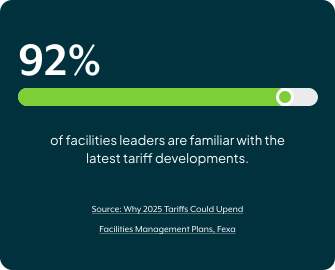
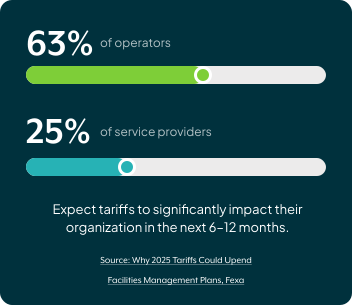
While most were aware of recent tariff developments, perceptions of urgency often differed by role. Roughly 63% of operators, including facilities managers and their teams, expected tariffs or related cost uncertainties to significantly influence their organization in the next 6 to 12 months. By contrast, about 25% of service providers said the same. Because operators control budgets, downtime risk, and the customer-facing consequences of delays, this difference in perception is notable.
In response, many facilities leaders focused on tightening prioritization and strengthening the business case for spending. Replacements and upgrades were increasingly framed as measures to protect uptime and manage downstream costs, rather than as discretionary improvements.
We can show analytically that we’re spending more to operate assets because of age. Even though it means spending money up front, replacing them saves money over time.
.png)
Readiness gaps widened.
Many facilities teams tracked the risk in 2025. Yet fewer teams built a mitigation plan that changed day-to-day execution. As a result, that gap showed up in vendor coordination, project planning, and the speed of internal decision-making.
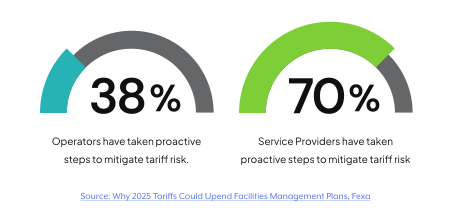
According to recent research, only about four in ten operators had taken proactive steps to mitigate tariff risk, while nearly seven in ten service providers said they had. That pattern suggests a real readiness bottleneck inside operator organizations. It also signals cross-functional friction. Mitigation often sits across procurement, finance, real estate, construction, and operations.
When there’s chaos around you, you have to bring clarity and purpose. You deal with situations as they evolve, and rely on your team to gather information so you can walk through it systematically.
Convenience Stores (NACS)

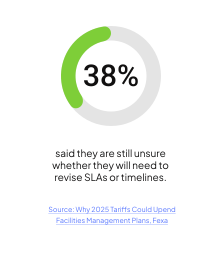
Uncertainty also carried into vendor expectations. About four in ten respondents said they were unsure whether they would need to revise SLAs or timelines. That uncertainty creates practical drag, slowing approvals, weakening accountability, and increasing time spent negotiating exceptions.
Facilities has long been measured by how well it avoids mistakes, not by how confidently it drives change. That balance is shifting as leadership teams look for owners, not just operators.

Compliance became operational work.
In 2025, refrigerant and emissions requirements demanded repeatable evidence and structured field documentation. Facilities teams needed consistent records and clearer workflows for service providers, since most required information originates in the field.
Key regulatory deadlines and thresholds illustrate just how operational this became last year. EPA Section 608 reporting was due March 1, 2025 for systems with 50+ lbs of Class I/II refrigerants that leaked 125%+ of full charge in the prior year. CARB reporting was due March 1, 2025 for California facilities with refrigeration systems using 200+ lbs of high-GWP refrigerant, with additional requirements based on size tier. These obligations require an asset inventory, reliable service records, and a consistent way to track leak events and repairs.
Talent shortages pushed teams to build capability.
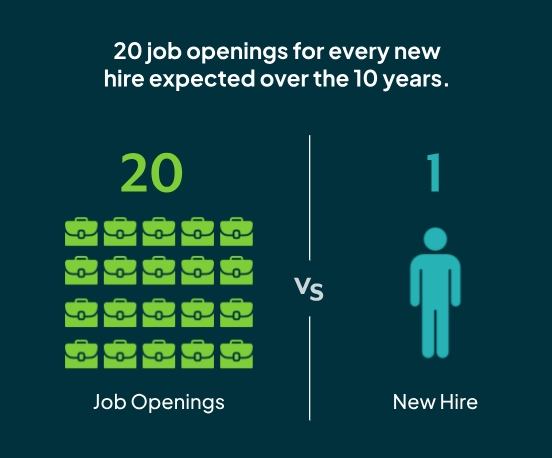
Facilities leaders increasingly planned for sustained labor scarcity in 2025. They designed workflows to reduce avoidable dispatches and repeat visits. They also leaned into training and role design as cost controls, because hiring alone could not close the gap. According to McKinsey, the market may see about 20 job openings for every new hire over the next decade. That imbalance raises the penalty for low-quality work orders and weak closeout notes. It also increases the value of training programs that improve intake quality and reduce unnecessary vendor calls.
Turnover cost is about $3,000 per crew person, based on the time invested in training. For manager candidates and facilities roles, it can be closer to $5,000.
.png)
Some organizations moved selected roles in-house to regain control over execution. For example, at Bath & Body Works, bringing support roles in-house delivered a 15% cost savings. That kind of shift can also stabilize response times and reduce coordination friction.

AI shifted to practical evaluation.
In 2025, more teams evaluated AI based on whether it improved execution quality, looking for faster intake, clearer triage, fewer repeat visits, and better decision support. They also focused on data discipline, because AI performance depends on input quality.
Gone are the days where companies are nervous about AI. The conversation isn’t about if we’ll adopt it anymore, it’s about how we’re going to roll it out, when it happens, and where it actually adds value.
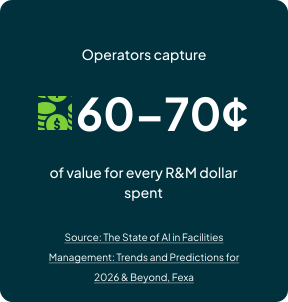
To frame the opportunity in economic terms, operators capture about 60 to 70 cents of value for every repair and maintenance dollar spent due to inefficiencies. That value leakage shows up in preventable truck rolls, unclear ticket descriptions, and incomplete documentation that forces rework.
AI starts to matter when it reduces that leakage. That typically means improving the first step in the workflow. It also means creating consistent records that teams can trust when they need to prioritize spend or defend compliance decisions.
Data is the lifeblood of AI. We can’t do anything meaningful with AI if we don’t have the data to support it, so we’ve had to organize and centralize information that used to live in spreadsheets or on individual laptops. We also use AI to find gaps in the data so we know what we’re missing and what the field needs to start collecting.

Tivo's Latest Video Trends Reveals Growing Consumer Interest in Video Services Bumdles Over Fragmented Streaming Experiences, Businesswire (October, 2025)
What’s New in 2026
2026 expands compliance scope, increases reporting exposure, and accelerates the shift toward AI-enabled execution.
An expanding scope for multi-site operators.
As of January 1, 2026, many more systems are now subject to refrigerant compliance requirements. Practically, this means a larger population of assets must be tracked, documented, and supported with consistent service records — expanding the operational burden for facilities teams and service providers.
For example, under the AIM Act Subsection (h), systems containing 15 pounds or more of HFC refrigerant must now comply with federal regulations. Systems with 1,500 pounds or more are also required to have automatic leak detection in place. Because of these thresholds, many organizations began preparation efforts well in advance. Together, these requirements broaden the compliance scope and elevate expectations for documentation and evidence quality.
Beginning January 1st, 2026, that threshold goes down to 15. Now assets with 15 lbs or greater that use an HFC refrigerant fall under the regulated category. That brings a whole new group of multi-site facilities into refrigerant management and tracking from a compliance perspective.

Compliance and climate disclosure reach expands.
Compliance risk will be easier to translate into financial risk in 2026. Penalties move the conversation from “should we do this” to “how do we prove we did it.” That dynamic increases executive attention and raises expectations for documentation discipline.T
The stakes are explicit: EPA fines can reach $60,000 per violation per day. California penalties for missing or incorrect emissions reports can reach $500,000 annually. Those figures sharpen the business case for operational controls, evidence standards, and quality checks.
This year, climate disclosure programs will also pull more companies into reporting ecosystems. Especially for organizations that operate in California or have revenue enterprise reporting demands than ever. thresholds that trigger disclosure obligations, facilities data are becoming more relevant to enterprise reporting demands than ever.
With a first deadline of January 1, 2026, the California Air Resources Board (CARB) released a preliminary list identifying about 2,600 companies potentially subject to SB 253 and about 4,100 companies that may fall under SB 261. Because SB 253 applies at $1B+ annual global revenue, and SB 261 at $500M+, these programs significantly increase the likelihood that facilities teams will be asked for asset inventories, emissions-adjacent equipment data, maintenance records, and evidence of controls.
Each property has its own sustainability scorecard. We use a consistent framework across the region, including climate action, waste reduction, water reduction, and responsible sourcing. It gives teams a repeatable way to manage sustainability work across a large portfolio.

The advantage shifts to execution quality and AI adoption.
AI adoption in 2026 centers on workflow-level performance. Teams look for speed and quality improvements that show up in daily execution. They measure value through fewer repeat visits, faster resolution, and less administrative drag.
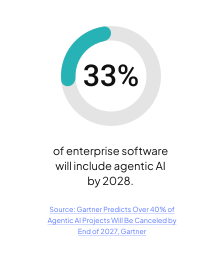
Up from near-zero in 2024, 33% of enterprise software will include agentic AI by 2028, according to Gartner. That direction matters for facilities teams because it signals that AI capabilities will increasingly be embedded inside the tools people already use. The differentiator becomes operational discipline: clean intake, consistent data, clear oversight, and repeatable workflows.
Facilities leaders also need governance around AI use as these tools enter daily workflows. Visibility into where AI is used, what data it touches, and what decisions it influences becomes part of operational risk management.
AI is a fundamental paradigm shift for facilities management. The productivity and efficiency of the industry is going to 10x in the next five years.

Responsible AI governance starts with visibility. That means maintaining an inventory of AI usage, understanding what data AI is using, and knowing what decisions it is influencing.

2026 Playbook for Facilities Leaders
Establish an asset system of record for critical categories.
Build complete, maintained records for high-impact assets, starting with HVAC/R and refrigeration. Treat the system of record as a daily tool that teams rely on for planning, dispatch, and decision-making.
Standardize naming conventions, location logic, and ownership. Define who updates records, when updates happen, and how changes get verified. Keep one source of truth that operators, vendors, and internal teams can reference confidently.
Define asset tiers based on operational impact at the site and portfolio level. Use those tiers to drive prioritization, response expectations, preventive maintenance cadence, and replacement planning.
KPIs to track:
% of critical assets with complete records
% of sites with complete asset inventory
% of work orders linked to an asset record
Standardize intake-to-closeout to stop work order leakage.
Define required intake elements by trade so every ticket includes the context needed for accurate routing and a first-time fix. Use structured inputs such as photos, symptoms, asset identifiers, and business impact. Add duplicate checks and simple troubleshooting gates before dispatch.
Reduce preventable vendor calls by resolving basic issues upstream through clear store guidance and consistent screening. Set completion requirements such as photos and enforce technician note standards before invoice submission, so teams have a usable history for trend detection, planning, and compliance documentation.
KPIs to track:
First-time-fix rate
Repeat work order rate (by asset and by trade)
Average time-to dispatch and time to-close
Treat compliance as an ongoing operational discipline.
Translate regulatory requirements into recurring tasks with clear ownership, due dates, and escalation rules. Frame compliance as a set of controls that run continuously across the portfolio.
Define minimum evidence standards for each requirement. Standardize how evidence is reporting efforts. captured, stored, and validated so teams do not rely on memory, informal notes, or one-off.
Audit internally on a fixed cadence. Use an exception workflow that assigns ownership, tracks remediation, and documents closure.
KPIs to track:
On-time completion rate for compliance tasks
Exceptions rate (missed tasks, incomplete evidence)
Time-to remediate exceptions
Reduce truck rolls by building operator capability and smarter triage.
Train store teams on submission quality and basic troubleshooting. Focus training on the actions that reduce preventable dispatches and improve the accuracy of vendor response.
Create clear escalation paths and decision trees for common issues. Define when a store should troubleshoot, when it should submit a ticket, and what information must be included for dispatch.
Use targeted insourcing where it improves uptime and cost control. Build internal capability in markets where density, response times, and repeat issues justify it.
KPIs to track:
Truck rolls per location per month
Preventable dispatch rate
Operator training completion rate
Vendor dispatch cancellation rate (pre-dispatch resolution)
Apply AI only where it improves workflow quality and speed.
Start with intake enrichment and triage support. Focus on use cases that improve ticket quality, reduce back-and-forth, and speed correct routing. Use AI to surface patterns and anomalies for human review.
Keep decision ownership with people who understand operational context, safety requirements, and business impact. Define human oversight rules and approved-use policies.
Specify which tasks can be automated, which require review, and what review completion looks like in practice.
KPIs to track:
Work order creation time
Intake completeness score
Routing accuracy rate (reassignments required)
Human review compliance rate
Treat vendors as an extension of the team with measurable accountability.
Create vendor standards for communication, evidence, and closeout quality. Define performance in terms of outcomes that facilities teams and operators actually feel. Implement scorecards and regular performance reviews tied to those outcomes. Treat performance management as a routine operating process supported by consistent metrics and shared expectations. Align SLAs to business impact. Match response expectations to the equipment and conditions that drive safety, uptime, and customer experience.
KPIs to track:
Vendor first-time-fix rate
SLA adherence rate
Closeout quality rate
Escalations per vendor per month
Industry Overview
Critical for us is life safety first. When you move to equipment, the priority is what produces the product. We sell chicken, so we need our fryers. If we can’t cook, we can’t sell.
.png)
Foodservice
Foodservice treats uptime as product availability. Equipment failures hit revenue immediately and disrupt operations fast. Pressure concentrates around revenue-critical equipment, refrigeration, HVAC, vendor speed, and operator execution. Small issues cascade when stores run at peak volume and staffing is tight. Top teams invest in asset criticality models, operator enablement, targeted insourcing in dense markets, and intake discipline that improves routing and first-time fixes.
Hospitality
Hospitality ties facilities performance directly to brand integrity and guest safety. Guests experience failures as trust failures, not maintenance issues. Pressure points center on water safety, fire and life safety, reporting integrity, and consistency across ownership models. Scale increases the need for standards, documentation, and accurate reporting. Top teams invest in standardized platforms, an audit-ready execution culture, risk-based prioritization, and predictive systems that support consistent documentation and earlier detection.
Guests need confidence that maintenance teams are doing the right things. Owners and associates need confidence too. That requires a platform for consistent execution and a culture where people can report accurately, including saying, ‘I didn’t accomplish this,’ and explaining why, so support can be put in place.
.png)
Facilities should be viewed as a key business partner, not an expense location. If we’re brought into conversations early, we can be proactive, avoid backtracking, and drive savings on the front end.
.png)
Retail
Retail locations operate as brand experience and operational node under tighter capital scrutiny. Facilities leaders manage long planning horizons with limited room for deferral. Pressure points include deferred maintenance, refresh cycles, vendor performance, and experience consistency across locations. Facilities work stays cross-functional because it intersects with real estate, construction, store operations, and risk. Top teams invest in lifecycle planning, cross-functional alignment, ROI storytelling to secure approvals, and preventive maintenance discipline that reduces emergency work.
Workplace / Office
Workplace and office environments run on higher tech density and shared ownership structures. Facilities teams deliver a consistent member experience while navigating landlord-operated base building constraints. Pressure points include HVAC boundaries, access control and low-voltage systems, AV and Wi-Fi reliability, building engineer coordination, and localized weather events. Top teams invest in tech-adjacent troubleshooting skills, targeted insourcing where response time matters, and structured upskilling programs that build systems fluency across the team.
Technology and facilities used to be in separate lanes. Now we cross over constantly because so many building systems and amenities are tied to technology. Facilities teams need enough technical understanding to troubleshoot and keep the member experience working.

Facilities managers need a solid property condition assessment, then they need to become better storytellers. If leaders cannot translate infrastructure condition into business risk and patient impact, they will struggle to get funding. Capital is finite, so facilities has to make the case clearly.
.png)
Healthcare
Healthcare facilities teams manage aging infrastructure alongside growth in outpatient delivery. Patient experience, safety, and continuity requirements raise the stakes of downtime and deferred work. Pressure points include modernization strategy, capital advocacy, condition assessments, and facility flexibility for evolving care models. Top teams invest in rigorous condition assessments paired with executive storytelling, long-range infrastructure planning, and flexible design approaches that support future care delivery needs.
Logistics / Distribution
Logistics and distribution environments depend on orchestration, route efficiency, and reliable handling conditions. Small disruptions can produce outsized downstream impact. Pressure points include driver workforce constraints, routing efficiency, warehouse workflow complexity, and temperature-controlled handling requirements. Top teams invest in route optimization, workflow automation, workforce retention systems, and process discipline that reduces variability and improves on-time execution.
Orchestration is very important. A well-run distributor relies on order tracking in real time, efficient routing, and planning for cold or cooler storage on trucks. The system works when the flow is coordinated across inventory, picking, and delivery.
.png)
The Future of Facilities
2026 expands compliance scope, increases reporting exposure, and accelerates the shift toward AI-enabled execution.
As cost volatility, compliance exposure, and labor scarcity persist, facilities teams will be evaluated on operational proof. Leaders will be expected to show that work was prioritized correctly, executed efficiently, and documented to standard. That expectation reshapes how teams design workflows, measure performance, and deploy technology.
Under these constraints, standardization becomes foundational. High-performing teams will rely on repeatable intake-to-closeout workflows that improve routing accuracy, reduce preventable dispatches, and enforce closeout evidence by default. This consistency allows execution to scale across sites, vendors, and trades without relying on individual judgment.
Compliance will also continue its shift into daily operations. Regulatory obligations function as continuous controls embedded into routine work with clear ownership, defined evidence standards, and visible exception handling. Teams that operationalize compliance reduce risk while avoiding reactive cleanup.
As for AI, it adds value when it strengthens workflow quality and speed. Clearer tickets, faster triage, and better routing will improve decision cycles, while structured data and oversight determine whether gains compound or stall.
As the industry moves forward, the advantage will shift to teams that treat execution as a system. They invest in standards, enforce quality, and apply AI deliberately to protect uptime, control costs, and operate with confidence in a low-margin environment.
Methodology
This editorial report draws on a mix of qualitative and quantitative inputs to reflect what multi-site facilities leaders are already experiencing on the ground: tighter cost conditions, expanding compliance scope, ongoing labor constraints, and a fast shift toward AI-enabled execution.
First, we synthesized recent findings from Fexa research, which provided the quantitative backbone of the report. Then, we analyzed interviews with operators, executives, and functional leaders across key multi-site environments. Several of these conversations also support standalone Facilities News feature stories and practitioner spotlights.
Finally, the editorial team at FacilitiesNews.com compared themes across research data and interview transcripts to identify where facilities teams are under the most pressure. Ultimately, we used this synthesis to isolate a small set of repeatable “next moves” focused on execution quality—asset visibility, workflow standardization, evidence-based compliance, partner accountability, and practical AI adoption—so leaders can act without relying on hype or one-off fixes.