

All articles
'Engineered Invisibility' and the Philosophy of High Stakes FM in Regulated Industries
Ivan Segovia, cGMP Facilities Coordinator for the USC/CHLA Cell Therapy Program, explains why a culture of trust is the key to navigating high-stakes compliance and financial risks.
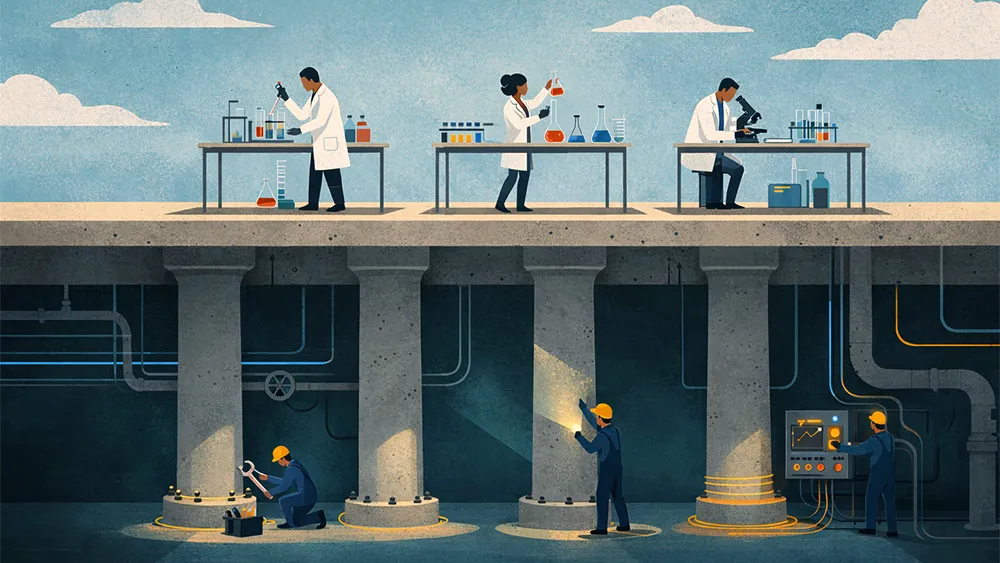

Behind every experiment, everything is already set up. Nobody sees the work, but because of that work, there are no mistakes and everything is ready to go.
In facilities leadership, success is invisible by design. The industry is built on the principle of engineered invisibility, where uneventful, uninterrupted operations are treated as the clearest signal that everything is working as it should. But in high-stakes lab environments where failure comes with serious safety, compliance, and financial risk, that philosophy carries more weight. Adopting it means embracing a level of proactive, disciplined execution that turns maintenance into a strategic function, pushing the role away from manual labor and toward data-driven, proactive facilities management.
Ivan Segovia lives this philosophy daily as a cGMP Facilities Coordinator for the USC/CHLA Cell Therapy Program. With a career forged in the highly regulated environments of the Cedars-Sinai Biomanufacturing Center and Pharmavite, Segovia knows firsthand that the best work is the work no one knows you did.
"Behind every experiment, everything is already set up. Nobody sees the work, but because of that work, there are no mistakes and everything is ready to go," he explains. In this framework, Segovia says, success is defined by preventing problems before they can materialize through proactive measures like checking equipment batteries days before an experiment.
Sound of silence: The quiet competence required for such a job creates a paradox in that the better you are, the harder it is to make a business case for the work's value. It's only when there's a mishap that the job comes into focus. "What I've noticed in every single industry is that if there's no noise and no complaints, everything is good. But at the same time, when the smallest things happen, you get so much noise from people complaining."
A sample of success: Segovia notes that while peers in the industry immediately understand the value of facilities expertise, internally, intricate solutions are often taken for granted. "For example, I made the printers wireless, but the solution was perceived as a simple convenience. It's so hard to make someone see what you see when they don't have the background."
To bridge that gap, Segovia believes facilities managers must also become translators, providing company leaders with important context surrounding their work. He treats the job as intellectual infrastructure design, using digital tools and real-time monitoring to stay ahead of issues. From this perspective, he encourages leaders to see their environment not as a single space, but as an interconnected machine that requires every part to work in synchrony. "I ask people, 'Is a car one unit, or is it millions of pieces working together?' To me, being industrious is the ability to see that everything is made of those millions of pieces and to understand how they all interact."
The everything manager: It's a view that matters more as roles expand with new regulatory and data demands. Because an FM understands how all the pieces work together, they become the natural point person for any problem, expanding the role far beyond its official description. "I'm a facilities coordinator, but I printed a sign for my door that reads 'DMP Customer Service' because when anyone has a problem, they call me. The complexity of my job is how fast I can solve problems."
The reactivity tax: Segovia's philosophy gets tested when the invisibility is broken by a crisis with no room for error. In his cGMP environment, an unexpected equipment failure like a cold storage unit dying on a weekend can mean millions of dollars in lost research, highlighting the high cost of proactive vs. reactive maintenance. Segovia views the conversation that follows as one of the most frustrating aspects of the job. "You cannot prevent everything. When mistakes happen, you're asked to explain, yet again, why you weren't able to prevent it. That's one of the hardest parts."
The pressure magnifies when a systemic failure is subject to the strict standards of regulatory compliance, like federal guidelines and aseptic processing standards. "For a regular laboratory, an event like this is a one-day nightmare. For us, it's something that can last ten days or a month because we need to make sure everything is properly documented."
No cutting corners: Segovia describes how a single incident can trigger a cascade of urgent decisions, all driven by the knowledge that any compromise could lead to expensive and important cell therapy material becoming contaminated. In such a situation, Segovia once again assumes the role of translator to ensure the proper cleaning protocols are followed. "I have to explain that the cleaning crew cannot be just anyone. They have to be properly trained. They have to clean in a certain manner."
For Segovia, what makes the high-pressure work sustainable is a culture of deep, unwavering trust that empowers decisive action. "With my boss, I don't have accountability. I have ownership. Accountability can feel like you're being babied, but with ownership, any problem becomes my problem to fix." He says replacing top-down accountability with a culture of ownership provides the resilience to absorb the pressures of the role and the motivation to continue the quiet, proactive stewardship that protects research, safeguards patients, and allows science to move forward. "I take so much pride in saying to my boss, 'we had this problem, but we got it resolved. Don't worry about it. Focus on other things that are more important.'"
.webp)