
All articles
The New Facilities Standard is Using Connected Data to Protect Working Capital
Facilities Engineer Michael King explains how unifying maintenance data into a single CMMS turns "invisible" building repairs into a high-leverage strategic asset for the boardroom.

Data is what shows our constituents and our board members the work we do, the numbers that we put up, and where our value pays off.

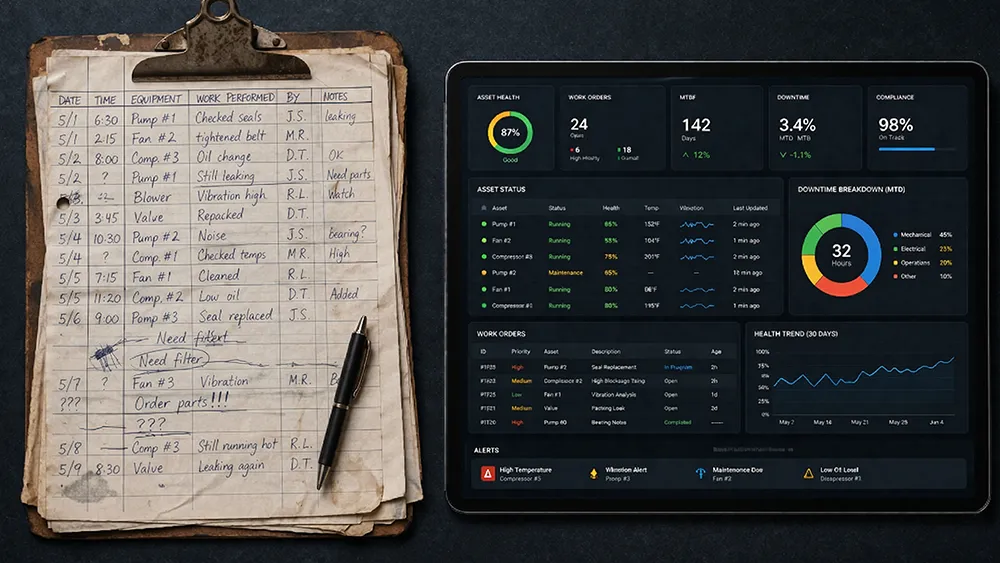
Facilities management has long operated in the background, keeping buildings comfortable and systems running while rarely getting credit for the complexity involved. But behind every resolved hot call and every piece of equipment humming along on schedule is a stream of operational data that most organizations are barely tapping. Unlocking real transformation in facilities hinges on consolidating the data those operations already produce into a single, integrated system that turns maintenance activity into strategic intelligence.
Michael King is living this reality on the front lines as a Facilities Engineer at Pedernales Electric Cooperative. With more than a decade of always-on facilities experience, King is skilled at using system performance data to help manage a redundant 2MW data center and has cut emergency repairs in half while reducing unanticipated downtime in high-demand environments. He says turning everyday maintenance into measurable performance data not only improves performance, but gives facilities leaders clout in the boardroom.
"Data is what shows our constituents and our board members the work we do, the numbers that we put up, and where our value pays off." He says for many teams, the problem is fragmentation. A CMMS handles work orders. Excel tracks asset details. Paper manuals sit in a truck. Contractor invoices live in someone's inbox. The information exists, but it's scattered and therefore not very useful. "My personal recommendation is to have an all-encompassing CMMS system so you don't have to worry about multiple platforms," he says. "This allows you to track preventative maintenance, reactive maintenance, and predictive maintenance all in one place."
Informing smarter procurement: Consolidation matters because it enables full lifecycle visibility across every asset, technician interaction, and maintenance event, which fragmented systems can't provide. When all of that lives in one spot, patterns emerge that would otherwise stay buried and one-off repairs become data points that inform procurement decisions. "Whether it be hard water for ice machines or an A/C unit having a refrigerant leak or a brand that's having multiple issues, consolidated data helps us steer away from that in future planning," King explains.
Beyond the work order: The operational benefits of integrated data are significant, but the strategic payoff may matter even more. Facilities teams have historically struggled to quantify their impact. King says a centralized CMMS changes that by quantifying the exact ROI of preventative care, allowing teams to justify specialized equipment investments with hard evidence of reduced downtime. "Some systems can be expensive, but they pay off in the long run as far as the information they allow us to track."
That proof of value becomes especially powerful as technology enables richer, more automated data capture. Today's tools already allow technicians to scan a barcode at a unit and pull up complete service logs, asset details, and maintenance history on the spot. The next frontier is eliminating manual data entry altogether. "Instead of having a technician have to go back and type his notes in, you could link your gauges to it so it's recording pressures in real time," King describes. The result is more efficient work, more accurate records, and documentation that doesn't depend on someone remembering to transcribe it hours later. "It'll allow and help the technician go faster, work smoother, and be more detailed, without having to write all that information out."
Playing the long game: King explains that dialing in such exact recordings with calibrated digital tools often protects working capital by delaying large capital expenditures. "Technology has increased the life expectancy of a unit because it allows us to get more information in less time," he shares. "Rather than just relying on a needle that may or may not have been calibrated correctly, we're able to get highly accurate details." When that precision feeds into a centralized data system, the cumulative effect is equipment that runs longer, costs less to maintain, and fails less often.
Smartphone side effects: King acknowledges that the convenience technology provides can also come with blind spots. When technicians are glued to a screen, he says, it's easy to miss obvious physical issues right in front of them. "It's like if you're going to a hot call and the door handle falls off in your hand. You're not even worried about it because you've got blinders on. The technology has taken away that care of fixing the door handle before going on to the next step."
In King's view, the larger story is less about technology and more about how facilities management is evolving from an invisible support function into a measurable, data-backed operation that directly contributes to business outcomes. The data has always been there, generated with every repair, inspection, and parts order. What's changing is the infrastructure to capture, unify, and act on it, and the organizations that do so will be the ones that unlock the full strategic value sitting inside their operations. "Facilities is what makes the world go around. It's what makes everybody's life at work comfortable," King says. "Now, we can build toward the future as we go instead of just being a parts changer."