

All articles
Fexa Turns Work Order Intelligence Into Enterprise-Wide Operational Leverage
Michelle Klaer, Director of Product Management at Fexa, outlines how purpose-built AI cleans up ambiguous work orders and embeds intelligence into daily facilities decisions.

Some teams are spending 10 to 20 percent of their time just clarifying work order details. That’s administrative drag pulling people away from strategic work.

Administrative drag is a silent tax on facilities management. Incomplete and ambiguous work orders can siphon a significant portion of a team’s time, triggering preventable costs across vendors, service calls, and SLAs. When AI is embedded directly into data intake and daily workflows, the resulting intelligence improves operations from the first touchpoint, not as a layer added after the fact.
Tackling this problem at its source is Michelle Klaer, the Director of Product Management at Fexa. As a product leader with more than a decade of experience driving innovation in agile environments, she has a front-row seat to the challenges of modernizing established industries. For Klaer, the path to true intelligent orchestration begins by addressing the fundamental problems first.
"Some teams are spending 10 to 20 percent of their time just clarifying work order details. That’s administrative drag pulling people away from strategic work. Improving data quality at the source changes everything downstream." She says refining data the moment it enters the system is what allows the financial benefits of AI to ripple through an entire workflow.
Tendspotting, enterprise style: Klaer maintains that deriving clear operational outcomes from AI requires solving the often unglamorous issues like work order ambiguity that carry heavy hidden costs. "AI is not just a buzzword. It's a meaningful operational advantage, but only when it's grounded in real workflows to solve real pain points." AI's real power here, she asserts, is in pattern recognition at a scale. "For example, if you look across thousands or millions of work orders, AI can begin to detect trends that no single individual would reasonably have time to spot on their own." Resolving these negative trends produces tangible outcomes in the form of fewer delays, reduced waste, and less frustration.
Zooming outward, AI's pattern recognition capabilities can be applied across the whole CMMS to predict failures, respond to incidents, and surface relevant details FMs can use to drive efficiency. Klaer says the key is intelligent orchestration that embeds the technology into everyday workflows and accelerates decision making. "We're moving from reactive assistance to proactive intelligence as a fundamental shift," she says.
AI anxiety: In an industry where market fears of AI disruption are a known concern, Klaer believes successful AI adoption must be approached as a change management initiative. What most companies get wrong, she explains, is treating it as a mere technology rollout. "AI introduces a deeper uncertainty connected to fears of losing control, of the system making bad decisions, or even of job displacement," she says.
Assistance before automation: To counteract this, she advocates for a trust-first framework. "We earn trust with AI by designing assistive intelligence before autonomous intelligence. That approach means keeping humans in the loop, building with transparency, and giving them control over the experience."
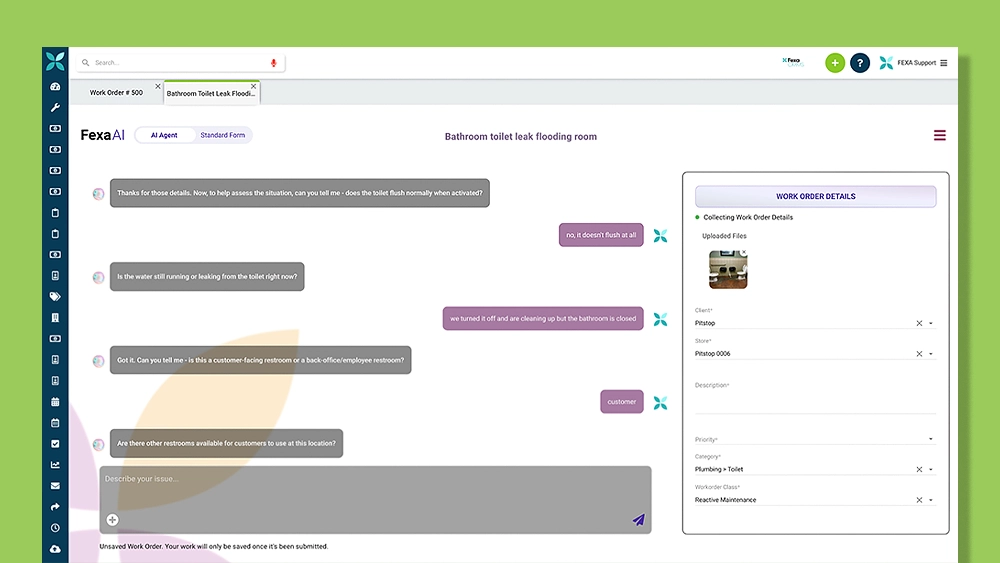
Fexa's strategy is to build this intelligence progressively, starting with work order creation and expanding into decision support, workflow confidence, and proactive operational monitoring. "When you connect structured data intake to intelligent answers and proactive monitoring, AI becomes more than a tool. It becomes an operational layer infused across the platform," Klaer says.
Purpose-built technology: She emphasizes that this approach is fundamentally different from simply layering a general-purpose LLM on top of an existing UI. "Facilities management has structured workflows, compliance requirements, vendor networks, SLAs, and cost controls. We also have historical performance data. We have configurations for all of the defaults and dispatch rules. That context matters so much to what an AI system needs to be effective." It's a proactive design that reduces the burden of manual oversight while leaving leaders in full control.
Looking forward, the near-term trajectory for the industry suggests a foundational change in the role of the facility manager. As AI handles more of the administrative burden, leaders are freed up to focus on strategic oversight. "The real surprise won't be in automation for automation's sake, but in how much cognitive overhead disappears," Klaer predicts. As AI matures across the industry, she says it will be orchestration rather than accumulation that's the definitive advantage. "The winners won't be the organizations with the most AI, but the ones with AI integrated and infused into their platform, making it part of the operational decision-making process."