

All articles
The Intelligence Era for Facilities Has Arrived, as AI Automation Breaks Reactive Maintenance Cycles
Monaire CEO Nish Kanapilly shows how facility teams can prove their value with ROI, data, and a step-by-step path to proactive operations.

This is the beginning of the intelligence era in the built environment. Because of everything facilities teams are being pulled into, you cannot get to all of that without intelligence and without embracing technology.

The facility manager role is expanding faster than the tools supporting it. Volatile energy costs, persistent technician shortages, and portfolios stretching across multiple locations have made the old reactive model unworkable, yet most teams still lack the visibility or resources to do anything else. The result is a mandate without a map: leaders are expected to hit energy reduction targets and protect uptime while flying blind across their own portfolios.
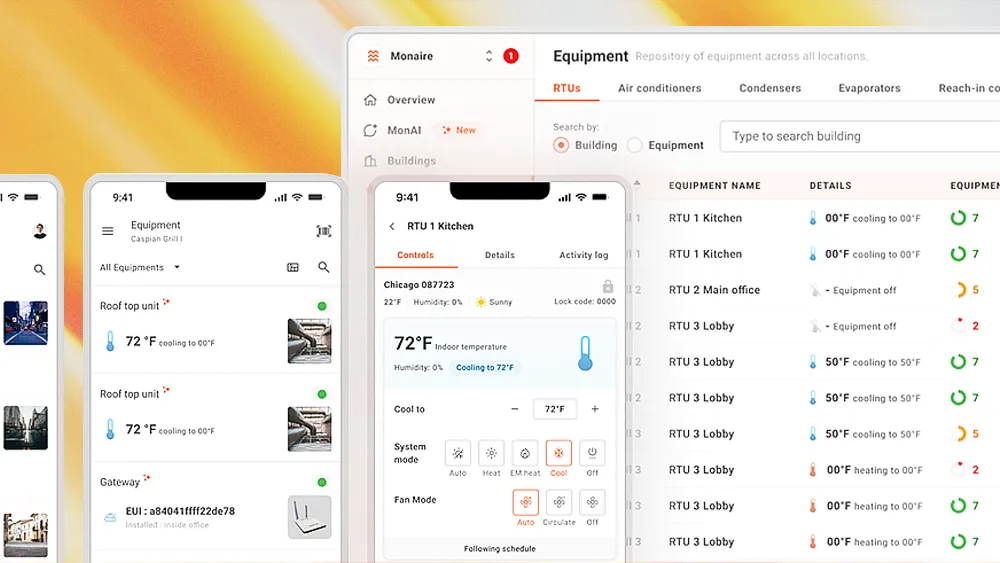
Nish Kanapilly, CEO and Co-Founder of Monaire, has spent his career at the intersection of HVAC engineering and business strategy. Monaire is an AI-powered platform that automates HVAC and refrigeration management for multi-site retailers and restaurant operators, combining hardware and software to shift teams from break-fix maintenance cycles to proactive control. Before founding Monaire, NIsh held sales leadership roles at Trane and RenewAire, giving him a front-line view of where the industry's blind spots run deepest. He believes that the path forward runs through data, and that the tools to act on it are more accessible today than most facility teams realize.
"This is the beginning of the intelligence era in the built environment," Nish says. "Because of everything facilities teams are being pulled into, you cannot get to all of that without intelligence and without embracing technology." The systems FMs manage are no longer just operational line items. When critical equipment goes down, people can't work and business can't sell. For teams stretched across locations, that exposure starts with a more fundamental problem: most don't have reliable visibility into what's actually happening across their portfolio.
For multi-site operators, that gap is most acute in high-performance HVAC and refrigeration. These systems account for roughly half of a building's energy costs and a majority of its repair tickets, yet for decades the standard approach has been purely reactive: wait for something to break, then scramble to fix it.
Flying blind: Without data, even the most capable FM is making decisions on instinct. "Many times a facility manager is responsible for 50 or 100 or 200 locations with no visibility and no control. In the absence of data, they are just struggling. When true data informs the decision, their impact becomes huge," Nish says. He sees AI-enabled system management as the practical answer, but getting there requires facility teams to build confidence incrementally rather than overhaul everything at once.
Crawl before you run: Nish's recommended approach is a gradual one. As the FM role continues to expand, leaders need a practical pathway to build confidence and demonstrate value. He advocates for a framework where teams start with small, data-driven wins before moving on to more ambitious optimizations. Tackling an energy reduction mandate by first identifying low-hanging fruit is a practical place to start. "It is a crawl, walk, run situation," Nish observes. "If a facility person is being tasked with more, it’s about helping them by putting information in a simple way they can understand, at level one. As they get more comfortable, you can have them dig into it more."
Technology rarely overcomes cultural barriers on its own. A classic disconnect occurs when an FM is tasked with reducing energy costs, yet the utility bill sits on the CFO's budget, leaving them with responsibility but no control.
Curse of the cost center: The fix, Nish points out, is to reframe the conversation entirely, shifting requests from operational needs into business cases tied to ROI. "They look at themselves as a cost center, and that’s unfortunate," he explains. "If you teach them to build a business case and tie their work to ROI and business value, people rally around that. It’s not just a cost, it’s value."
Discomfort is a compass: That same reframe applies personally. Nish advocates for a willingness to be "vulnerable in learning," approaching professional growth through podcasts, articles, and conference sessions. "People get so bogged down by their work they forget to set aside time for reflection and learning. You will almost always find that the things you struggle with are the things you hate to do, but they are the strategic tasks given to you. If you really hate to do it, you just have to find out what others are doing about it and leverage the greater community to learn more," Nish adds.
The intelligence era doesn't replace facilities expertise: it amplifies it. Nish points to automating low-level tasks as the practical starting point, giving FMs bandwidth to focus on the strategic work that actually moves the needle. "They don't want to be running around because they got a call that a space is hot, go check it, call a contractor, follow up when the contractor doesn't show up, and then find out the problem wasn't fixed," Nish says. "You don't want to waste all that time. Automate that."